The gamification voyage to drink more (… water) and improve your health

Even if you have never heard of Gamification before, it is likely that you have used it. Although it is not a commonly used and known term, it can be used in your everyday life.

Gamification is the use of gaming designs and elements in non gaming settings to help a user discover their inner motivation and obligations with the result of being rewarded. This can create a short/long term gain and/or change. (Nicholson S 2015, p. 19-20) 

Video Games Controller GIF By Anchor https://media.giphy.com/media/6hoKQifMan35m/source.gif

Johnson et al. affirms that if an individual employs the use of gamification, it can appease psychological needs such as the sense of accomplishment. Therefore, improving behaviours which if using an application for your health this could advance health based behaviour. However, it is also proclaimed in their text that the behaviours and motivators that are desired, could be intrinsic within the individual thus, it can be more up to the individual to intrinsically improve their health behaviours. Hence why gamification can be used as a persuasive technology that assert extrinsic motivators that generate reward and defuse the intrinsic habits. (Johnson et al., 2016 p. 90-91) 

Health is such a universal topic and there are many organisations whose sole purpose is to improve health worldwide. In order to do this many organisations and businesses have created applications. In these applications they allow people worldwide to improve their health and wellbeing in many different ways that can meet the needs of society. 

Drinking water is vital for our health, in order for bodily functions and systems to occur and be maintained. As Kristen Smith asserts, it is vital to consume an adequate intake of water to assure that your body can function efficiently by the ingestion of the water and absorb the nutrients. (Smith K 2017, pg2) 

While we are in isolation it’s hard to keep track of what day it is, little known if we are drinking enough water or not! I’m not sure about you but while I sit at my desk for various days in a row my subconscious voice tells me to eat more (when I wish it told me to drink water) while I stare I wonder why I have a beaming headache – probably because I haven’t had a drink all day!  

After researching for a bit, I asked my friends on twitter if applications have helped them, unfortunately the percentage of the poll for that option was very low. Despite this I thought I’d give an application that can assist me a go.
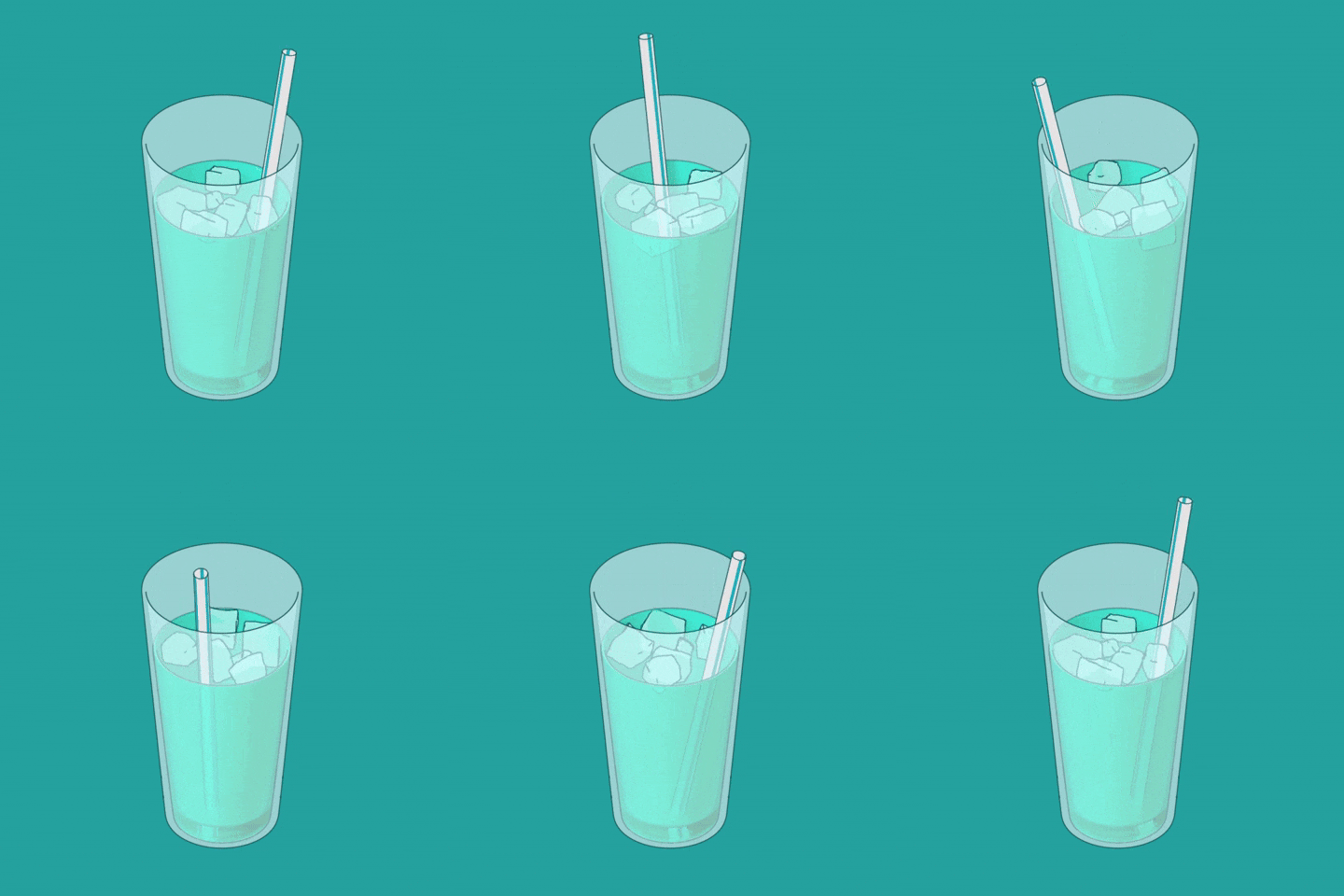
Thirsty Ice Water GIF By ZinZen 2016 https://media.giphy.com/media/l2YSowMXk0Qu0DFm0/source.mov

I downloaded and read the reviews about an application that supposedly helped me to drink my goal amount called “Waterlogged” however, I seemed this application to be ineffective as it didn’t remind me to drink water, it only had the amount of how much I needed to drink at the top of the app, and once you had water the bottle would fill up you would get a level up and get a larger amount to drink the next day. Overall, there wasn’t enough gamification that can create motivation within the application to alter my intrinsic behaviours.

This made me frustrated as I was really aiming to find an app that would satisfy my need for a little bit more excitement and reward – the thrill that gamification can give. After doing my research, I downloaded “Plant Nanny 2” and straight away it appealed to the gamification fix I was desiring. It is an interactive application that allowed me to adequately measure and know how much I was drinking. Every time I drank and met my daily requirements my idolised plant would grow. With this came reward, as you received coins to buy items and modify your plant such as a nicer pot for your plant etc. ultimately using this application creates a sense of accomplishment for me and ensures I drink enough water at the same time! 

Plant Grow GIF By Michael Shillingburghttps://media.giphy.com/media/3oEjHOUcNRKgpqTHiM/source.gif

Below I have documented my use of the application “Plant Nanny 2” and how it has worked for me and my daily drinking: 

Thank you for taking time to read my blog and watch my video. 

Ella Smith

REFERENCES

Johnson, Daniel, Deterding, Sebastian, Kuhn, Kerri-Ann, Staneva, Aleksandra, Stoyanov, Stoyan & Hides, Leanne 2016, ‘Gamification for health and wellbeing: A systematic review of the literature’, Internet Interventions, vol. 6, November 2016, pp. 90-1. [ACCESSED 24TH APRIL 2020]

Nicholson S. (2015) A RECIPE for Meaningful Gamification. In: Reiners T., Wood L. (eds) Gamification in Education and Business. Springer, Cham [ACCESSED 24TH APRIL 2020]

Smith K. (2019) Sugar Alcohols; Benefits of Drinking Water with Meals and Snacks, Environmental Nutrition [ACCESSED 23RD APRIL 2020]

Rotter J. (2019) Drink more water with the ‘Plant Nanny2’ hydration app, https://download.cnet.com/news/drink-more-water-with-the-plant-nanny2-hydration-app/ [ACCESSED 21 APRIL 2020]

The screen recording in my video: PlantNanny2 (FOURDESIRE CO, LTD 2018)

(All gifs have been referenced under the gif)
Fluent gamification?

I am lucky enough to have travelled (prior to Covid-19) a lot. However, the place that holds my heart is Italy. My mother is Italian and therefore I am half, and when we travel there I sometimes find it difficult to talk to my cousins. I did Italian classes when I was 5, however, i think I was too young for the challenge, especially when my family spoke a dialect at home. When I went to high school I started to do Italian as a subject, I visited Italy that year and I again found it difficult as I only knew the basics and my family spoke in a dialect.

My friends and I have always wanted to go on a BIG Europe trip in second year university and it felt like the larger proportion of Melbourne 20 year olds were too. Prior to our travel plans being canceled due to Covid-19, I stressed as I was going to live with my Italian family by myself for two weeks and to be honest, I knew no Italian except for hello and goodbye. Thus like many others, my new years resolution was to learn Italian, enough to get me through the trip. Therefore, I decided to have a go at Duolingo as it has 300 million users world wide (& that says something). Duolingo is a free application that has 30 languages plus available to learn with a tap of your finger.

Duolingo promises to teach you a language and to keep this promise they use a range of gamification to engage the student and motivate them to be persistent in learning a new language. Gamification is the use of gaming designs and inputs in non-gaming settings to motivate and inspire individuals to for example, want to learn. On their website they make it clear that their technique for students to learn is gamification with their four principles of; personalised learning, receiving immediate grading therefore the user stays motivated and improves quickly.

Duolingo implements personalised learning due to having lessons customised to your learning and therefore the student receives immediate grading instantly after they complete the challenge and further, they quickly show you what needs improvement. When the student does excel, Duolingo motivates them through rewards such as earning virtual coins, unlocking new challenges and seeing your progress through your score. Due to their studies, it has displayed that 34 hours of practice on Duolingo is the equivalent to a university semester of a language subject.

Thus, I decided to give it a go and yes I did find it engaging but it didn’t really feel motivated to continue once I got something wrong as I felt as though it was a bit repetitive when you got it wrong even if you understood your mistake after 2 seconds. However, I really liked how persistent it was with me if I hadn’t been online that day. A notification would come through at the same time everyday to tell me I hadn’t been active enough that day and I had to learn my Italian. Therefore I would jump on and do my daily requirements. However, I didn’t find it as motivating as I expected as I there wasn’t really much reward for the early days of learning and I feel as though to keep a student engaged, the rewards would have to be evident in the beginning.

Overall, I do like learning on Duolingo and I will hopefully become more fluent in Italian through the application. Below I have attached a video from Duolingo’s youtube if you wanted to find our more about the great learning application.

Ella 🙂

Youtube video created by Duolingo to further your understanding of the application

Attendance Zoom!

Due to the circumstances that we are currently living in, we still need to attend university and get a degree (also get our social fix somehow) thus, various applications like Zoom have allowed this to happen. Zoom is the original software-based conference room solution used around the world, started in 2011 therefore has allowed our class to still interact weekly. On Zoom you can either be seen or not seen, heard or muted. For example, in our ALM201 class we all show ourselves on camera with our mic on mute which means if we want to add something to the conversation or ask a question, we can either unmute ourselves or type it in the meetings message panel. It was a bit confronting the first class but now we feel very comfortable. However, some students may feel as though that showing their face could discourage some from participating. Zoom can both motivate and demotivate students because although it may be easier as we don’t physically need to travel to campus, this can also be demotivating since not actually being at university which helps students to be inspired to work hard by being in the correct learning environment, home presents the issue of having new and multiple distractions being present at almost all times. However, according to the unit chairs, the attendance is still below 50%. While this can be seen to be a negative due to 50% slacking off and not coming to class, could be also viewed as positive since 50% of students have been motivated and successful with the transition to online, making the attendance level constant compared to a significant dropping in attendance, as there is in other classes. 

After some thinking and engaging in conversation via email and google doccing (Via zoom), Kate and I came up with ideas that could include gamification to boost attendance.  For example, on the uni page (cloud) there could be a rewards points system that is visible to you, other students and your uni chair when you have attended the required lectures on Zoom. For example; 6/6, 4/6 and then ranked against your classmates based on who has the highest attendance rate and, as a result, get a mark of High distinction, Distinction, Credit, Pass, Fail etc. for attendance levels. This could be available for all students to see so they can see not only what their attendance level is, but how theirs compares to their peers for each subject and therefore be not only held accountable by staff, but by their peers. This could boost motivation to not only attend but participate with the class as they do not want to fall behind in odd times like these where they have a lot of spare time. There could also be a notification system where students will have a countdown to their class on the day so that the zoom isn’t missed and you kind of can’t really get away from notifications if you’re on your phone. We could also introduce a more in depth attention indicator onto Zoom available to be seen by everyone in attendance, where the mentors can see if the students are engaged such as a notification to the mentor if the student has gone offline to another website or turns off the camera. Therefore another points system could be introduced and the student gets to see a percentage of some sort to measure engagement that the students and teachers can both see in order to motivate them to increase as they try to get the percentage higher each lesson. 

We hope you liked our ideas on how to include more gamification into Zoom!

By Ella Smith and Kate Rolston

Us collaborating on Zoom

The Digital Divide

By Ella Smith

For the focus of my video for this project, I chose the topic surrounding the digital divide of; “Digital media has seen new divides form and old divides grow wider, but can also be used to diminish the divides that separate.” To be honest, when beginning this video about this topic, I thought that it would have been easier to create arguments and inform the audience than it was. Originally in my draft, I kept repeating myself and for me stringing out relevant information was a challenge for me. The main points that I found interesting about the divide was surrounding the topics of Education, the handicapped portion of society, the National broadband network (NBN), the location and rurality of those in Australia and comparing the indigenous Australians to the non-indigenous Australians. I chose to focus on Australia for a large proportion of the video as it is a prevalent issue in which the negatives need to be abolished and the positives need to rise above in order for the digital divide to not be a major matter of our society. In my video, I did not want to focus on the elderly as I felt as though it is a popular topic to focus on when talking about the digital divide. I also feel as though as a society, we are always developing and new generations form, the elderly segment to this issue will not be as relevant in times to come. Thus, personally I thought that it is a topic that doesn’t grow wider as soon enough everyone who has access to it will know how to use it. I also shun a light on the positives on the divide and how the positives can assist the negatives from becoming unapparent within society.

For my video, it took many drafts of my topic as I am personally not the best writer known to man and also my lecturer changed my mind a few days before it was due about the video and data being more Australian based. Therefore, my script only formulated the day I began filming also. I filmed on my Apple Iphone XR as I believe it is great quality and clarity of the picture and it also picks up sound really well. I put my computer on a box which gave the framing of the video height, and I then lent my phone upon my computer and begun to film. I filmed my video in the afternoon which I was in some shots lucky with the lighting and others it would either have too much shadow or too much light. I corrected this issue by using Imovie (what i used to edit the video) with editing video by using various tools on I movie to colour correct and give some sort of improvement of a filter.

 During my video, I have created a graceful but upbeat music that I made myself on Garage Band. The volume of this music, is 6% as I don’t want it to divert the audience’s attention so that they understand my voice clearly and also for the ambience of the video to not be totally silent and awkward. I received contrastive feedback from my last video and I wanted to bring the things that I did well into this video and leave the not so good behind. Thus, in this video I have spoken to the camera more and not just videos that I have filmed myself, it creates more of a personal video. However, I have had a part where I only used pictures from Flickr with creative commons licences that I could use. In this section of the video, I have done a compilation of images that relate to the digital divide and none of them pop up for more than 0.2 of a second as in this part of the video I talk about how diverse the topics are and how it has grown over time but also negatively declined. Therefore, I wanted this segment to reflect that.

Besides my script writing issues that I have stated previously, my other issue was a common issue of making eye contact with the lens instead of the of my script that was on the computer. I overcame this issue by reading my sentence before filming and did my video in short segments. However, I am happy with my filming as it didn’t need too much editing and cropping of the individual videos.

Scholarly articles

Broadband in the Burbs: NBN Infrastructure, Spectrum Politics and the Digital Home | Apperley | M/C Journal. 2019. Broadband in the Burbs: NBN Infrastructure, Spectrum Politics and the Digital Home | Apperley | M/C Journal. [ONLINE] Available at: http://journal.media-culture.org.au/index.php/mcjournal/article/view/400. [Accessed 23 September 2019].

digital inclusion index. 2018. Roy Morgan. [ONLINE] Available at: https://digitalinclusionindex.org.au/wp-content/uploads/2018/08/Australian-digital-inclusion-index-2018.pdf. [Accessed 25 September 2019].

Reference:

Digital Divide Council. 2019. The Pros and Cons of Digital Divide (Advantages & Disadvantages). [ONLINE] Available at: http://www.digitaldividecouncil.com/digital-divide-the-pros-and-cons/. [Accessed 27 September 2019].

All pictures used are from Flickr and have a creative commons license.

Artificial intelligence ! #ALM102

In my video, I have sectioned and divided it into five different parts. Throughout my video it has delicately upbeat music that I made myself on Garage Band. The volume of this music, is 3% as I don’t want it to distract the viewer so they understand my voice clearly and also for the video to not be totally silent.  The video beings with my introduction where I outline the establishment of the software and exactly what artificial intelligence is. Moreover, I then differentiate the types of artificial intelligence. Subsequently I give the example of Netflix and how their software is an exemplar of artificial intelligence. I then conclude with my scholarly article which specifies on the ease it provides to humans. Throughout a majority of my video, I have placed two videos over each other, then altered the opacity. I did this as I wanted to create a hallucinated, off, strange and aberration visual that makes the viewer somewhat uncomfortable and uncertain. I desired to give off this impression as though my research, I found that the general contentious was that people were more weirded out by the machines rather than accepting. Therefore, the overlapping of the videos creates this ambiance. With these videos, I have filmed two of the vital sensory properties that artificial intelligence is firstly met by; the ears and eyes as I believe that they externally assist and create intelligence within a human being.

I begin my video with the history of artificial intelligence and what it is. In this part, I visually present it with the overlay of my eyes, which I did to create my interpretation of what human’s expressions would be if they were listening to a machine displaying artificial intelligence for the first time. Therefore, I have presented my introduction through it getting read out by a computer-generated voice, which reflects what a device such a ‘google home’ or ‘Siri’ would imitate.

I then switch to the difference between weak and story artificial intelligence. In this fragment of the video, I have ears overlapping each other in two directions as there are two types of artificial intelligence. The ears are the body part that listen to the for example smart speakers, which are activated by voice commands. I have switched to my own narration from this part of the video onwards as the computer-generated voice, can create disengagement among the audience because I only produced the computer-generated voice to create effect at the start of the video.

I then filmed myself turning on Netflix on my television as I used Netflix as an example of strong artificial intelligence. This is seen to be strong as it assesses the viewers previous watching’s then recommends similar shows of movies. By doing this Netflix hopes to gain customers and keep their current ones.

I then conclude my video with my scholarly article which affirms that artificial intelligence is actually beneficial to society as it creates further ease in everyday life. I chose this article as it contrasts with my reasoning behind the overlapping of the videos – viewers that may think that computers are taking over. While I read this to the viewers, I have screen recorded “Siri” on my Apple mobile which is an apple software. I then contrastingly film myself on “Siri” as different perspectives of someone viewing artificial intelligence and somebody actually using it.  

Thus, I really enjoyed learning and researching about artificial intelligence however I did find the whole concept of creating a video on it quite challenging as I didn’t know where to really begin. However, overall, I am happy with my video.

REFERENCES:

Simon, H., 1983. Machine Learning An Artificial Intelligence Approach. 1st ed. USA: Springer, Berlin, Heidelberg.

‘Voice Text to Speech Reader, Apple Mac, 2019’

ALM102 Video Exercise reflection

By Ella Smith

To be honest, I found filming my ALM102 introduction assignment very challenging and testing however rewarding and exciting at the same time. I have always had a love for videoing and editing videos; for example, my family, friends or the landscape. However, I have never spoken on camera and shared it to the internet and therefore the filming of this video really put me out of my comfort zone. I assume that it puts me out of my confront zone as it makes me feel vulnerable to my larger network of “friends” online if they don’t know me personally. Thus, to showcase my “authentic self” and love for editing I split my video into two sections; with my first section including an introduction of myself where I enlighten to the audience my studies and career aspirations. My second section includes my interests such as my family and friends, dancing, the beach, camping, festivals, music, food, my dog and overall just having a good time.  

I didn’t plan my video in writing until I had to sit down and speak to the camera because as soon as I got the criteria of the assignment, I knew I wanted to do something creative which engages my audience but also gets them excited for my coming video assignments! After thinking for a while I decided that I wanted to display my editing skills, from there I begun to make my interests edit. This involved me going through all my videos that would suit this section and if it had identifiable people in it, making sure that I would be able to attain their signatures and permission to be in it. As this slowly developed I then begun to write my script however, I really put this to the side as I didn’t realise how nervous and insecure I became to sit down and speak to the camera. A million thoughts filled my mind as I started becoming particular on minor things such as my appearance, lighting, backgrounding etc. Every time I begun to film the lighting was never and it always washed me out I then settles for my kitchen bench as there are downlights behind me that didn’t wash me out too much although I wasn’t too happy with the final lighting in the end. I lent my computer on three thick books with my computer brightness up, I placed my phone resting on my computer with my script behind as a prompt if I needed it. The overall sound I am quite happy with as I am luckily able to film on my iphone XR which has very good sound.

I filmed myself speaking through my script 5 times but as I was very nervous to film and record this section, I felt as I though I was stuttering and I was looking at my script a lot. Therefore, I had to go through those 5 recordings and filter out the best parts of each one. Due to this, it meant that I had to edit my video to ensure that if there were snippets from different and that they flowed.

Overall, my greatest challenge was my insecurity to post this video, to allow people to see me in a different light. However, I really do enjoy the subject and how it does make me push myself to participate in things that I am not used to consequently, I put my uncertainties behind me and begun to film!    

Hope you enjoy !

Watch the final product !
Permission of friends and family that are identified in my video

The benefits and limitations are involved in using digital media to facilitate student learning and engagement

In my podcast, I have sectioned and divided it into four parts. It begins and ends with delicately upbeat music that I made myself on Garage Band. The podcast then goes onto my introduction where I outline what I am going to talk about in my podcast but I also give an overview of the topic that I am going to cover . Moreover, I then address the limitations and disadvantages that arise with digital media becoming a big part of students life. Subsequently I speak about the benefits in the next part, I then conclude by summarising the topic and then trailing off to the music I began with.

I commenced researching my topic by going through the lecture resources and study notes surrounding the content of week 10. This allowed me to get a further understanding and building on what I already learnt in class. In class, we focused on sexting and cyberbullying and how common it is in educational institutes. Thus, in my podcast I wanted to touch on that and how it arises when digital media is involved therefore I incorporate it into my podcast as a limitation and disadvantage. For my benefits part of my podcasts, this is where I decided that I wanted to incorporate two scholarly sources as expert opinions to assist in my arguments. I have included expert opinions from Sara Eskridge who is an Adjunct Professor of History Randolph-Macon College Ashland, VA and Carla Dawson Digital Marketing Professor at the Catholic University of Cordoba. They assert how in order for digital media to benefit students and their learning, the educational institutes must adapt and imbed digital media in their teaching in order to assist the students and their learning styles and the endless possibilities that digital media can create for their classes and learning.

I thoroughly enjoyed; scripting, recording, editing and uploading my podcast as it allows me to be creative in my learning and therefore I wanted to create my own music.I created my own music rather than using some of Creative commons licensed source material within my podcast. As I have already stated, my podcast begins and ends with delicately upbeat music that I made myself on “GarageBand” (an application on an Apple Mac) which I hope gets the listeners excited about what they are about to listen to. The music is a combination of Cuban Timber Tonga and a techno beat then fading out with upbeat electric piano which together reflects a sound that I would reflect and relate to myself – upbeat but not the most flamboyant person in the room.  

To be honest, I found that the hardest part for me was finding appropriate scholarly quotes and articles that suited my podcast. They either didn’t really flow with the topic as a whole or weren’t appropriate about what I was talking about in that section. However, the longer I searched the more appropriate and fitting my two quotes were it just took time and I learnt that I just had to put in extra effort which I was happy to put in. I also found the editing of the podcast difficult as I had never edited something like the podcast before so therefore although it was challenging, I did learn how to work it for the podcast and times to come.     

Center for Social Impact Communication. 2019. How Social Media is Reshaping Today’s Education System – Center for Social Impact Communication. [ONLINE] Available at: csic.georgetown.edu/magazine/social…ucation-system/. [Accessed 27 May 2019].

Preville, P., 2018. How Digital Textbooks Make Learning More Impactful. 1st ed. America: Topthat.

My online identity

I use social media every day and the internet it is becoming more central in our lives every day. Everyone has different online identities that link to their likes and interests. My online identity was established in 2012 and personally, my online identity has defiantly altered since. I actively post and my posts now have different contexts on each form of social media due to what I want to post and who follows me. My online identity began on was Instagram, solely due to the fact that it was a new phenomenon and all my friends had it. However, since 2012 my thoughts, purposes and intentions have changed surrounding why and what I post. Whereas on Facebook I believe that my main purpose is to message my friends and stay in contact rather than posting updates. My most authentic form of social media is Snapchat due to not caring as much of others thoughts of me due to having the power of adding who I like and only accepting those who I know personally. I never had Twitter before studying Social media and so far I haven’t posted as much as my other sites therefore having little identity portrayed.

Instagram would be my most active form of social media. Back in 2012 I would have just followed my friends and would have posted at random with photos that I wanted my 12 followers to see with the Instagram name of @ella_bub that I made up. However, over the years my online identity altered due to many factors such as going into high school, making more friends etc. Thus, this changed my online identity as I started to care and my username and look quickly changed to Ella.smitth. Although throughout my change of identity I have always loved to post Instagram photos where I have random filters and use whitty captions to share to my following of now just not my close friends but acquaintances and so on. Whereas on my second Instagram account, I only post very random stuff to my close friends and don’t think about what I am going to post and when I am going to post it or how I look. It is an authentic representation of me. Overall my Instagram identity is subjective depending on the account or the mood I am in that day.  

On Facebook, my identity is quite different to my Instagram but also similar in some ways. I don’t actively post on Facebook unless I am updating my profile picture which isn’t often. However, when I do upload my profile picture it takes a while to choose that as the one, the one that I share to my friends of what I want them to see me as. In some way, I think my profile picture classifies my online identity and others identity as it’s what you see them as online when you are talking to them and is the main focus. My Facebook is totally private and I have never accepted a friend request from someone I have never met or heard. I feel as though although private it does have a lot of information about me on there if someone went stalking. So therefore, my actual identity is more evident on Facebook then a fake one that some people might fake.

My online identity on snapchat is my rawest form of social media. Even my bitmoji is ugly. On snapchat I don’t share my location on Snapmaps due to not wanting everyone to be able to see where I am therefore I keep it private. However otherwise on snapchat I share all. I couldn’t care less about what I look like on snapchat and neither do any of my friends therefore I believe that they also help me create that online persona as it makes me feel comfortable to be myself.

Twitter is the form of social media I post on the least and have developed little of my identity on there. My Twitter is for university purposes and therefore my online identity is guarded due to being a formal account as my tutors follow, however I also post how I feel about assignments therefore twitter is more of a raw side of my online identity.

As Angela Thomas asserts in her book ‘youth online: identity and literacy in the digital age’ that “online identity is about the authoring of self as a living-out of these states of being, becoming, belonging and behaving through a range of everyday social and discursive practices that are connected with the body. Yet it is also about a close editing of self…” This quote reflects my online identity as sometimes my online identity is subjective due to wanting to fit in but also to be myself.

Thomas, A., 2007. youth online: identity and literacy in the digital age. 1st ed. New York: Peter Lang publishing inc..